Kubernetes Deployment Architecture
This page describes the full production deployment architecture on a managed Kubernetes cluster. A cloud provider can be selected below for provider-specific details.
Application Stack Components
The AI/Run CodeMie application consists of multiple integrated components organized into functional categories:
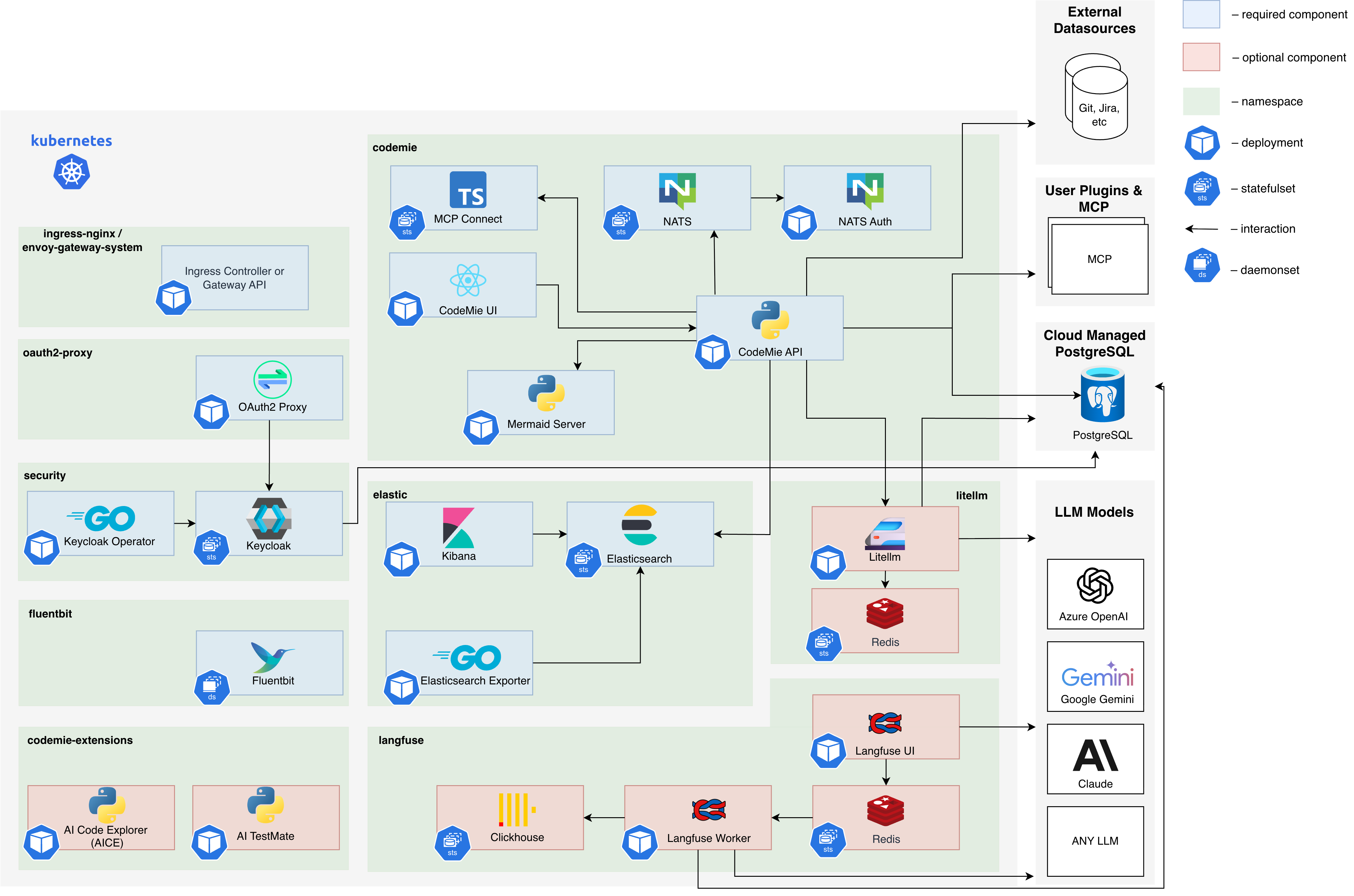
Core AI/Run CodeMie Services
Proprietary services that provide the main AI/Run CodeMie functionality:
| Component | Container Registry | Description |
|---|---|---|
| CodeMie API | europe-west3-docker.pkg.dev/.../codemie:x.y.z | Backend service handling business logic, data processing, and API operations |
| CodeMie UI | europe-west3-docker.pkg.dev/.../codemie-ui:x.y.z | Frontend web application providing the user interface |
| NATS Auth Callout | europe-west3-docker.pkg.dev/.../codemie-nats-auth-callout:x.y.z | Authentication and authorization service for NATS messaging (Plugin Engine component) |
| MCP Connect | europe-west3-docker.pkg.dev/.../codemie-mcp-connect-service:x.y.z | Bridge enabling CodeMie to communicate with MCP servers |
| Mermaid Server | europe-west3-docker.pkg.dev/.../mermaid-server:x.y.z | Diagram generation service for visualization in chats |
Data Layer
Database and search components for data persistence:
| Component | Container Registry | Description |
|---|---|---|
| Elasticsearch | docker.elastic.co/elasticsearch/elasticsearch:x.y.z | Primary data store for AI/Run CodeMie (datasources, projects, conversations, etc.) |
| Kibana | docker.elastic.co/kibana/kibana:x.y.z | Analytics and visualization interface for Elasticsearch data |
Security & Identity Management
Authentication and authorization components:
| Component | Container Registry | Description |
|---|---|---|
| Keycloak Operator | epamedp/keycloak-operator:x.y.z | Manages Keycloak deployment and configuration |
| Keycloak | quay.io/keycloak/keycloak:x.y.z | Identity and access management (IAM) solution providing SSO, authentication |
| OAuth2 Proxy | quay.io/oauth2-proxy/oauth2-proxy:x.y.z | Authentication middleware integrating with Keycloak for secure access |
Infrastructure Services
Essential Kubernetes infrastructure components:
| Component | Container Registry | Description |
|---|---|---|
| Nginx Ingress Controller | registry.k8s.io/ingress-nginx/controller:x.y.z | Routes external traffic to internal services |
| Storage Class | Cloud-provider CSI driver (EBS, Azure Disk, or GCP Persistent Disk) | Provides persistent volumes for stateful components |
Messaging & Integration
Message broker for Plugin Engine:
| Component | Container Registry | Description |
|---|---|---|
| NATS | nats:x.y.z | High-performance messaging system for Plugin Engine communication |
Observability
Logging and monitoring components:
| Component | Container Registry | Description |
|---|---|---|
| Fluent Bit | cr.fluentbit.io/fluent/fluent-bit:x.y.z | Lightweight log collector enabling agent observability |
Optional Components
Components that can be omitted based on configuration:
| Component | Container Registry | Description |
|---|---|---|
| LLM Proxy | – | Optional proxy for load balancing and high availability of AI model requests and usage insights |
Deployment Dependencies
Components must be deployed in the following order due to dependencies:
- Infrastructure → Ingress Controller, Storage Class
- Operators → Keycloak Operator
- Data Layer → Elasticsearch
- Security → Keycloak (with database credentials), OAuth2 Proxy
- Messaging → NATS
- Core Services → CodeMie API, UI, MCP Connect, NATS Auth
- Observability → Fluent Bit, Kibana
- Optional → LLM Proxy (if needed)
Cloud Infrastructure
A cloud provider can be selected below for provider-specific infrastructure details.
- AWS
- Azure
- GCP
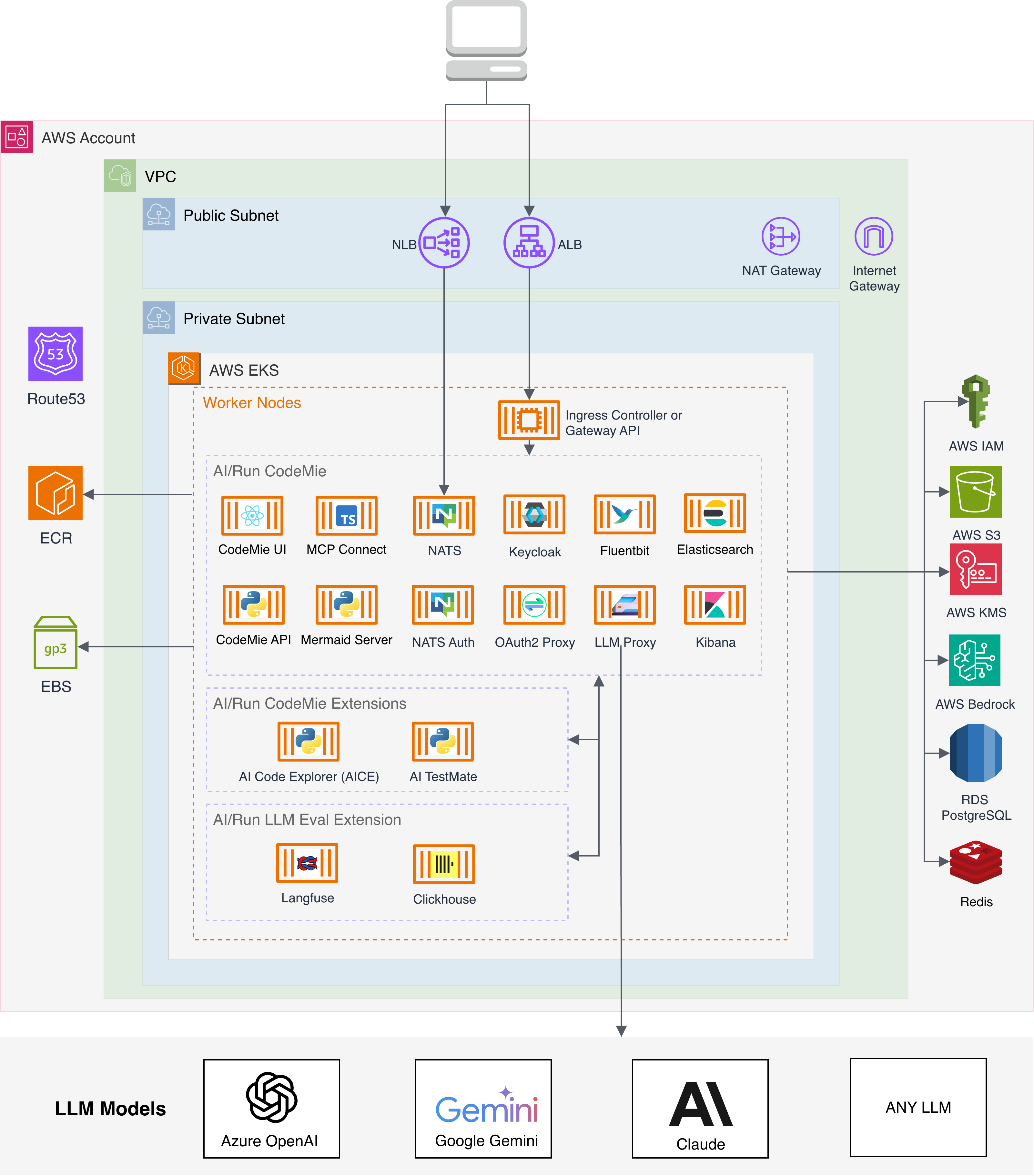
AI/Run CodeMie is deployed on Amazon Elastic Kubernetes Service (EKS) with supporting AWS services for networking, storage, and identity management.
High-Level Architecture Diagram
The diagram below illustrates the complete AI/Run CodeMie infrastructure deployment on AWS:
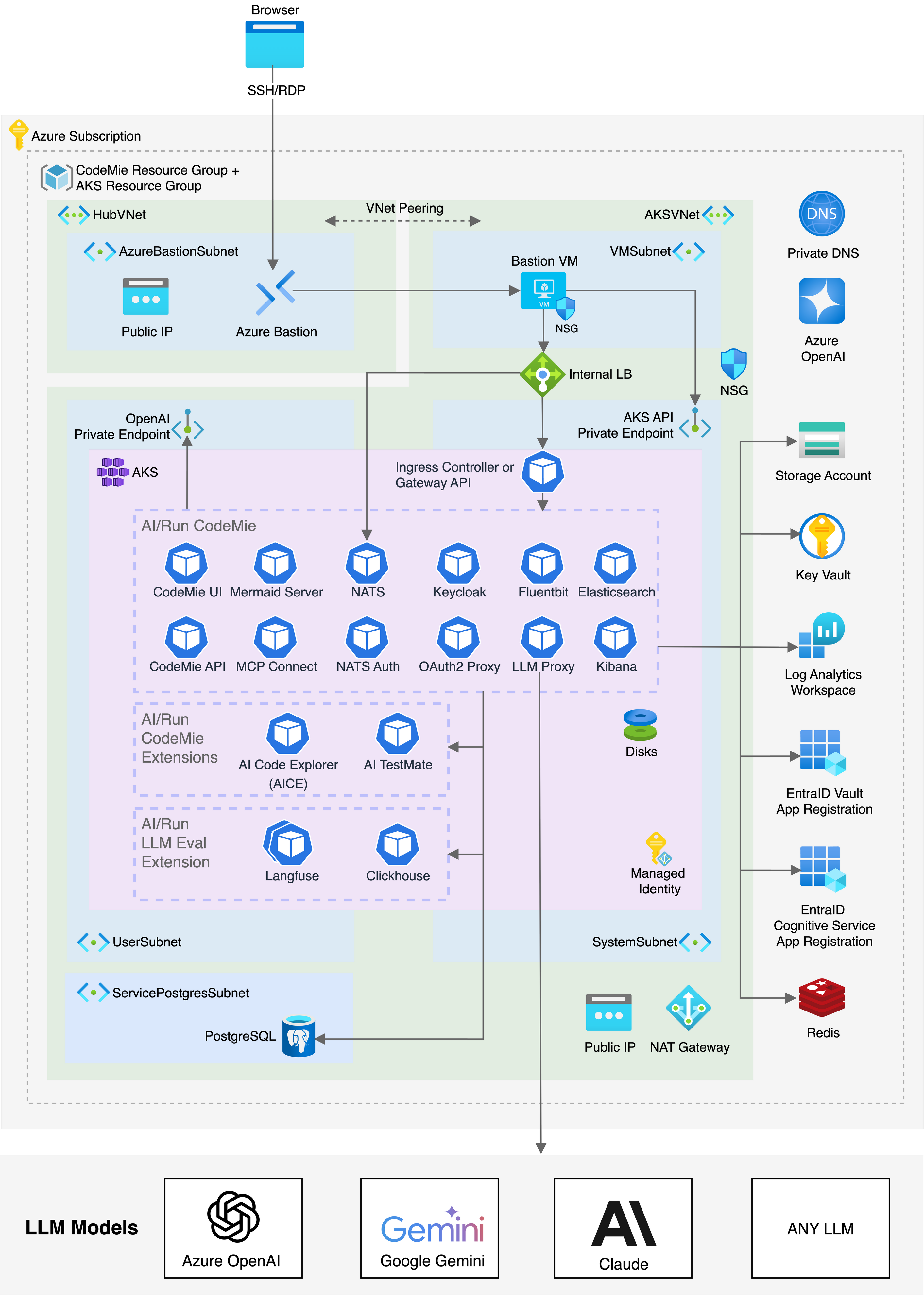
AI/Run CodeMie is deployed on Azure Kubernetes Service (AKS) with supporting Azure services for networking, storage, and identity management.
High-Level Architecture Diagram
The diagram below illustrates the complete AI/Run CodeMie infrastructure deployment on Azure:
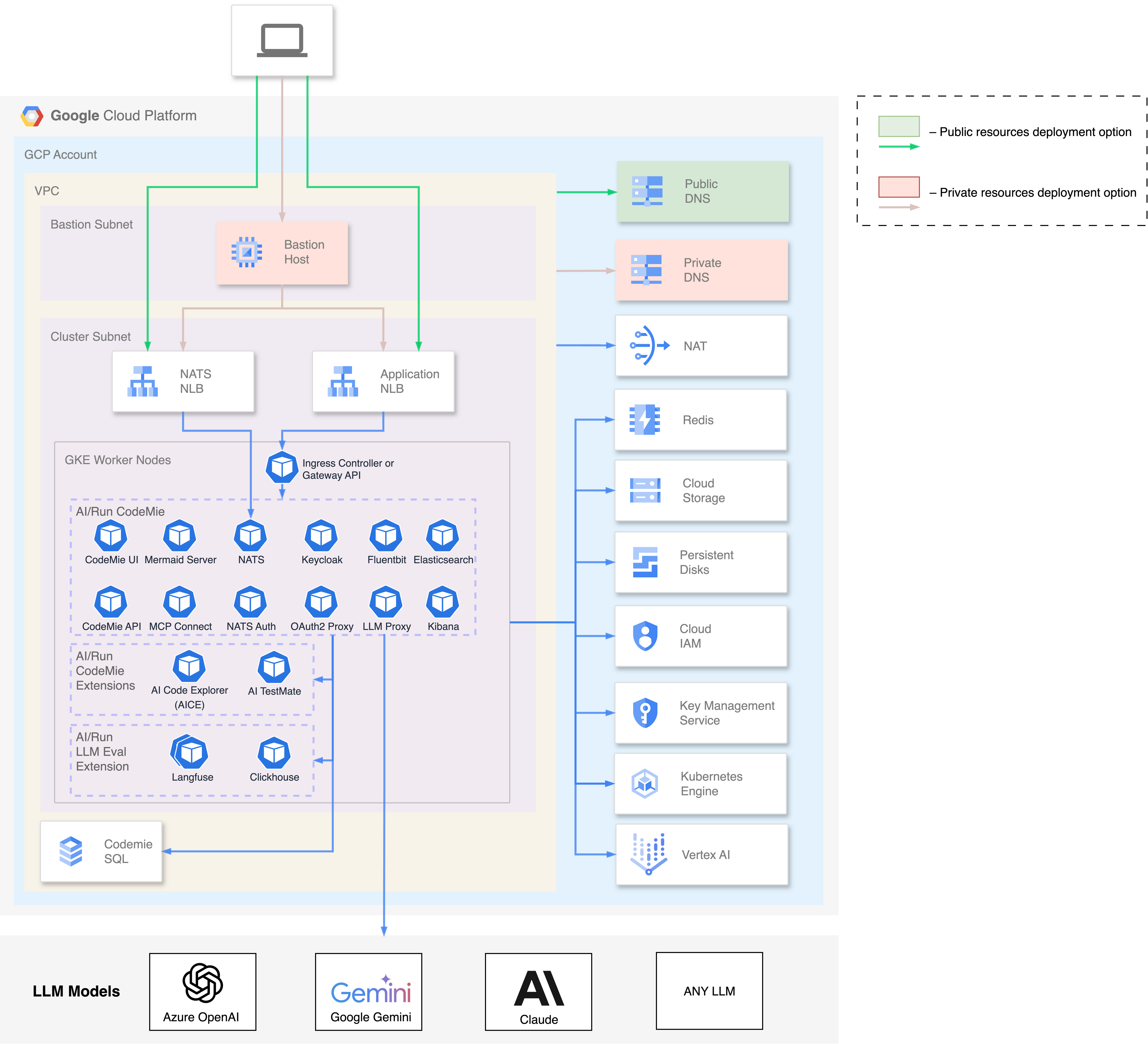
AI/Run CodeMie is deployed on Google Kubernetes Engine (GKE) with supporting GCP services for networking, storage, and identity management.
Deployment Options
There are two deployment options available depending on your organization's access requirements:
- Public cluster option - Access to AI/Run CodeMie from predefined networks or IP addresses (VPN, corporate networks, etc.) using public DNS resolution from user workstations
- Private cluster option - Access to AI/Run CodeMie via Bastion host using private DNS resolution for enhanced security
High-Level Architecture Diagram
The diagram below illustrates the complete AI/Run CodeMie infrastructure deployment on GCP:
The architecture can be customized based on your organization's security policies, compliance requirements, and operational preferences. Consult with your deployment team to discuss specific requirements.
Kubernetes Resource Requirements
Container Resource Requirements
The table below specifies resource requirements for AI/Run CodeMie components sized for high-scale production deployments supporting 500+ concurrent users.
| Component | Pods | RAM | vCPU | Storage |
|---|---|---|---|---|
| CodeMie API | 2 | 8Gi | 2.0 | – |
| CodeMie UI | 1 | 128Mi | 0.1 | – |
| Elasticsearch | 2 | 16Gi | 4.0 | 200 GB per pod |
| Kibana | 1 | 1Gi | 1.0 | – |
| Mermaid-server | 1 | 512Mi | 1.0 | – |
| PostgreSQL | Managed service in cloud | – | – | 30-50 GB |
| Keycloak PostgreSQL (optional) | Managed service in cloud | – | – | 20 GB |
| Keycloak | 1 | 4Gi | 2.0 | – |
| Oauth2-proxy | 1 | 128Mi | 0.1 | – |
| NATS + Auth Callout | 1 + 1 | 512Mi | 1.0 | – |
| MCP Connect | 1 | 1Gi | 0.5 | – |
| Fluent Bit | DaemonSet | 128Mi | 0.1 | – |
| LLM Proxy | 1 | 4Gi | 1.0 | – |
The listed requirements are designed for high-scale production deployments. For smaller teams and lower concurrency, some resources can be scaled down:
- User Concurrency: API replicas can be scaled depending on the load
- Data Volume: Elasticsearch stores vector datasources, user metrics and container logs, therefore storage grows with datasources amount and size and log retention policies
- Database Sizing: PostgreSQL managed service tier depends on user count and the amount of resources they create in CodeMie. When Keycloak uses a dedicated database instance, each instance can be sized independently; when Keycloak shares the CodeMie database, the combined workload must be accounted for when choosing the service tier
- LLM Proxy: Resource requirements depend on the exact LLM proxy type being used